Positroid Structure in ReLU Networks
A single-hidden-layer ReLU network with \(H\) hidden units and \(d\)-dimensional input partitions \(\mathbb{R}^d\) into activation regions via \(H\) affine hyperplanes. These hyperplanes define an affine matroid of rank \(d+1\) on the ground set \([H]\), encoding the combinatorial structure of the decision boundary. I’ve been asking: when the weight matrix is constrained to be totally positive (all minors nonnegative), is the resulting matroid always a positroid?
This question sits at the intersection of two literatures that, as far as I can tell, have not been connected before: the combinatorics of positroids and the totally nonnegative Grassmannian (Postnikov, Knutson-Lam-Speyer, Lam) on one side, and the geometry of neural network activation regions (Hanin-Rolnick, Balestriero-Baraniuk) on the other.
Totally positive (TP) matrices arise naturally in neural networks through kernel parameterizations like \(W_{ij} = \exp(a_i \cdot b_j)\) or \(W_{ij} = 1/(a_i + b_j)\), both of which produce TP matrices by classical results. Positroids — matroids realizable by points in the totally nonnegative Grassmannian — are characterized by elegant combinatorial structures: Grassmann necklaces, decorated permutations, and plabic graphs.
The question, then: does total positivity of the weights propagate through the affine hyperplane arrangement to constrain the activation matroid to be a positroid?
The answer turned out to be more interesting than a simple yes or no.
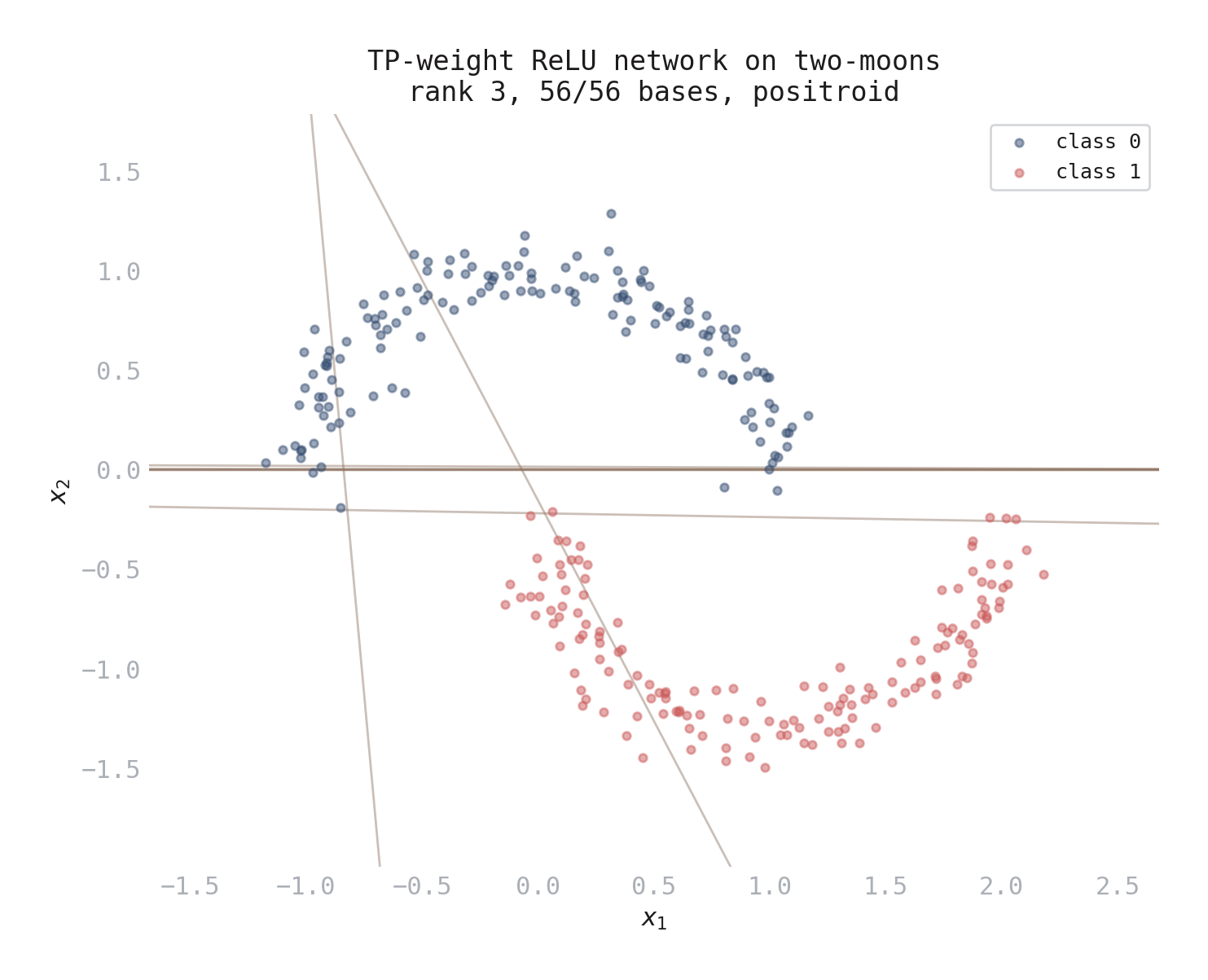
Figure 1. A TP-weight ReLU network trained on the two-moons dataset. The 8 lines are the hyperplanes \(\{x : w_i^T x + b_i = 0\}\) from the first hidden layer. Together they define an affine matroid of rank 3 on the ground set \([8]\). In this case the matroid is uniform (all 56 triples are bases), so it is vacuously a positroid.
800 Trials: The Conjecture
I trained single-hidden-layer ReLU networks with TP-constrained weights across a range of configurations: two-moons, concentric circles, spirals, XOR, and PCA-reduced digits datasets; exponential and Cauchy kernel parameterizations; hidden dimensions \(H \in \{4, 6, 8, 12, 16\}\); input dimensions \(d \in \{2, 3, 5\}\).
Over 800 trials, every affine matroid produced by a TP-weight network was a positroid. Zero counterexamples. The conjecture appeared robust.
There was a catch, though. Most trials produced uniform matroids — matroids where every \(k\)-subset is a basis — which are vacuously positroids regardless of weight structure. Non-uniform positroids only appeared in one configuration: exponential kernel on two-moons with \(d=2\). There, up to 50% of trials at \(H=16\) produced non-trivial positroids with rich structure (hundreds of bases, consistent decorated permutation patterns).
The 1-parameter degeneracy of both kernel families (hyperplane normals confined to a curve in \(\mathbb{R}^d\)) and the low rank (\(d=2\) gives rank-3 matroids) left the conjecture plausible but weakly tested. So rather than run more training experiments, I decided to attack the conjecture directly.
12,642 Counterexamples: The Conjecture is False
The mechanism for constructing counterexamples is simple. For a TP weight matrix \(W \in \mathbb{R}^{H \times d}\), the affine matroid of \([W \mid b]\) has rank \(d+1\). A \((d+1)\)-tuple \(S\) is a non-basis if and only if the dependency coefficients \(c_S\) (from the left null space of \(W_S\)) satisfy \(c_S \cdot b_S = 0\). This is one linear equation on the bias entries indexed by \(S\), leaving all other biases free.
TP structure constrains the weights but places no constraint on the biases. For \(d=2\), the dependency coefficients of any triple \((i,j,k)\) from a TP matrix have sign pattern \((+, -, +)\). Choosing biases to make a spread triple like \(\{0, 2, 4\}\) a non-basis (elements non-contiguous in cyclic order) is always satisfiable, and the resulting matroid is not a positroid.
I ran 16,820 targeted trials across configurations with \(d=2\) and \(H \in \{5, 6, 8\}\), producing 12,642 counterexamples. The construction works for every TP matrix tested. The smallest counterexample is \(d=2\), \(H=5\): any TP matrix \(W \in \mathbb{R}^{5 \times 2}\) with biases chosen to make \(\{0,2,4\}\) a non-basis gives a non-positroid (9 out of 10 bases, fails the Grassmann necklace test).
The counterexamples cluster by construction strategy. Crossing pairs (two interleaving non-bases) succeed at ~89%. Single spread non-bases succeed at ~73%. But contiguous non-bases — sets of the form \(\{j, j+1, \ldots, j+k-1\} \bmod n\) — produce positroids in every case. Not a single contiguous non-basis pattern yielded a non-positroid matroid.
The Dichotomy
The disproof revealed a clean split. Non-basis patterns fall into two classes: cyclic intervals (contiguous arcs on \([n]\) arranged in a circle) and non-intervals (spread or crossing patterns). The first class always gives positroids; the second class often does not.
Gradient descent on TP-weight networks, across all 800+ training trials, produces only contiguous non-basis patterns. It never generates spread or crossing patterns. The original conjecture held for trained networks not because of any algebraic property of TP matrices, but because of the implicit bias of gradient-based optimization.
This shifts the conjecture from a static algebraic claim to a dynamical one. The revised conjecture: for TP-weight networks trained by gradient descent on binary classification, the affine matroid of the learned hyperplane arrangement is always a positroid. This is a statement about the interaction between TP structure and training dynamics, connecting positroid combinatorics to the implicit bias literature in deep learning theory.
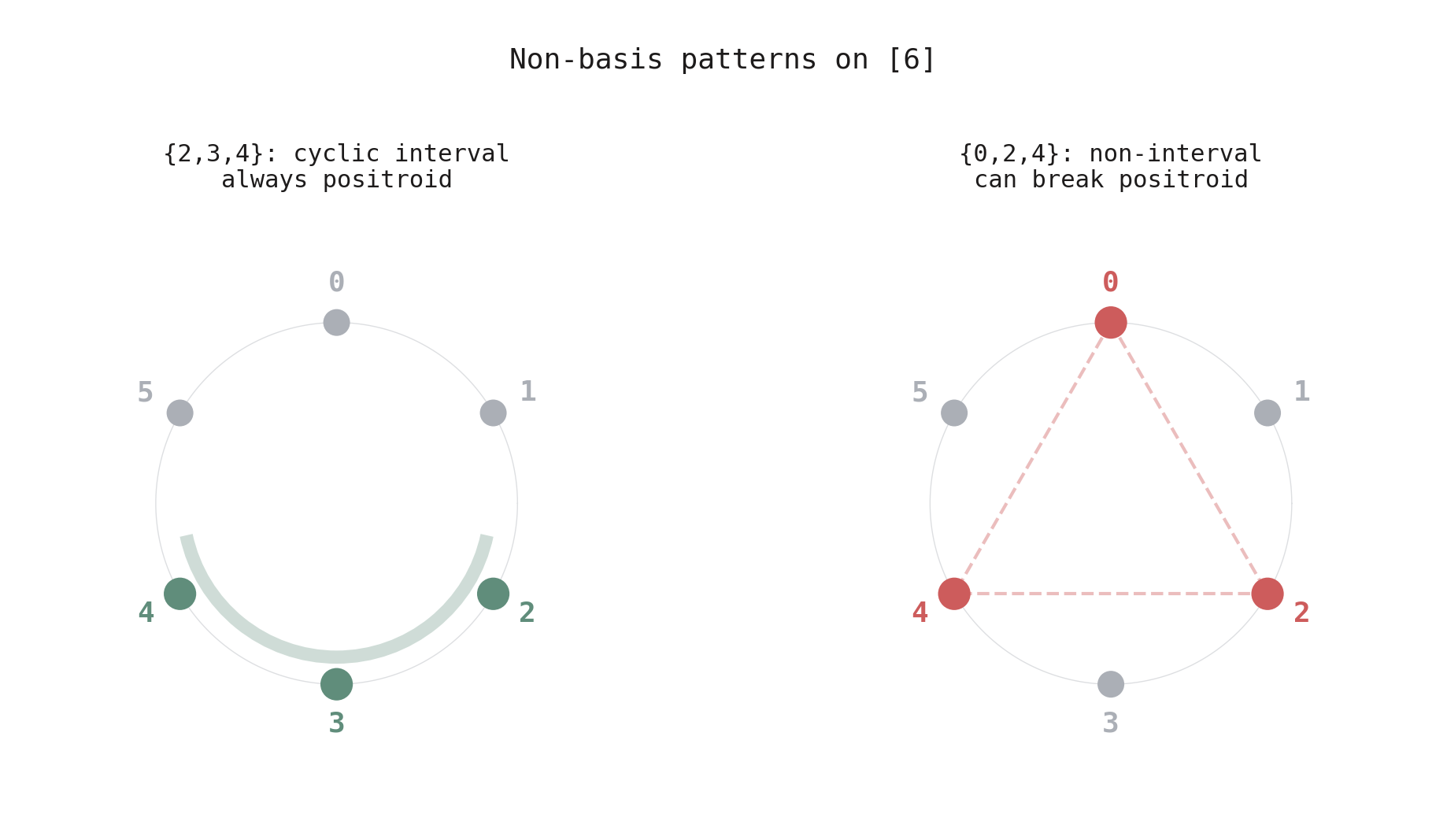
Figure 2. The two types of non-basis on \([6]\). Left: \(\{2,3,4\}\) is a cyclic interval — its elements form a contiguous arc on the circle. Removing it from the uniform matroid always gives a positroid. Right: \(\{0,2,4\}\) is a non-interval — its elements are spread with gaps. Removing it can break the positroid property.
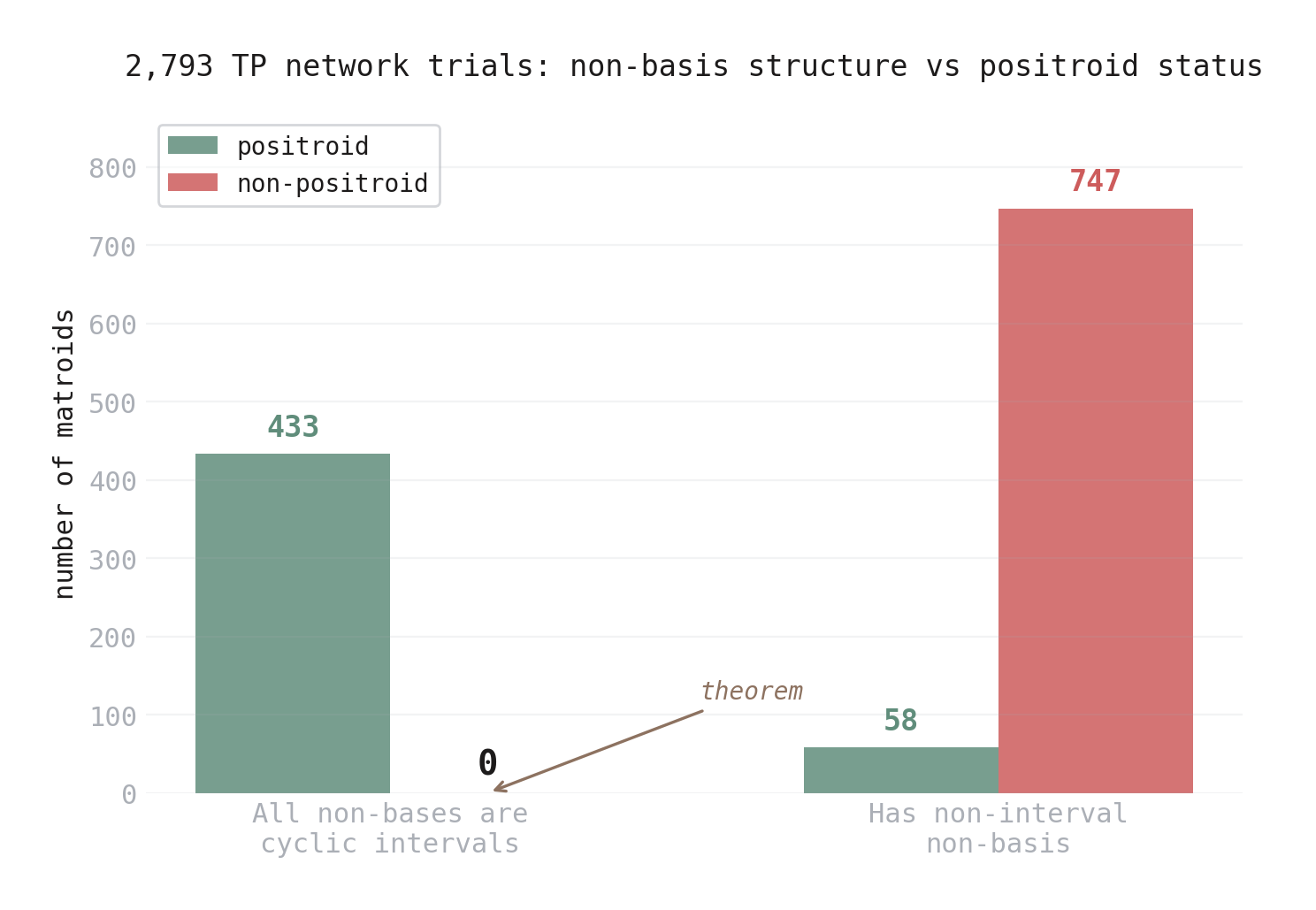
Figure 3. Results from 2,793 TP network trials, classified by non-basis structure. When all non-bases are cyclic intervals: 433 positroids, zero non-positroids — the zero is the theorem in action. When any non-basis is a non-interval: 58 positroids, 747 non-positroids.
But the zero in the left column of Figure 3 demands explanation. Why should contiguous non-bases always give positroids? Is this just a pattern, or is there a structural reason?
The Contiguous-Implies-Positroid Theorem
It is a theorem.
Theorem. Let \(M\) be a matroid of rank \(k\) on \([n] = \{0, 1, \ldots, n-1\}\). If every non-basis of \(M\) is a cyclic interval — a set of the form \(\{j, j+1, \ldots, j+k-1\} \bmod n\) — then \(M\) is a positroid.
The proof uses the Grassmann necklace / Gale reconstruction characterization: a matroid is a positroid if and only if its basis set \(\mathcal{B}\) equals the Gale reconstruction set \(\mathcal{R}\) from its Grassmann necklace.
The standard direction \(\mathcal{B} \subseteq \mathcal{R}\) follows from the matroid greedy algorithm. The key observation for \(\mathcal{R} \subseteq \mathcal{B}\) is that a cyclic interval \(\{j, j+1, \ldots, j+k-1\}\) is the Gale-minimum \(k\)-subset in the cyclic order \(\leq_j\) starting at \(j\) — it consists of the first \(k\) elements. If this interval is a non-basis, the Grassmann necklace entry \(I_j\) (the lex-min basis in \(\leq_j\)) must be different from it, and since \(I_j\) is a \(k\)-subset it Gale-dominates the interval. So the interval fails the Gale condition \(S \geq_j I_j\) at position \(j\) and is excluded from \(\mathcal{R}\).
Since every non-basis is a cyclic interval, every non-basis is excluded from \(\mathcal{R}\), giving \(\mathcal{R} \subseteq \mathcal{B}\). Combined with \(\mathcal{B} \subseteq \mathcal{R}\), we get \(\mathcal{B} = \mathcal{R}\), so \(M\) is a positroid. \(\square\)
The Corollary
There’s also a clean if-and-only-if for single removals.
Corollary. For \(2 \leq k \leq n-2\), the matroid \(U(k,n) \setminus \{S\}\) (uniform matroid with one basis removed) is a positroid if and only if \(S\) is a cyclic interval.
The forward direction is the theorem. The backward direction: if \(S\) is not a cyclic interval, then every cyclic interval \(\{j, \ldots, j+k-1\}\) is still a basis, so the Grassmann necklace satisfies \(I_j = \{j, \ldots, j+k-1\}\) for all \(j\). Since every \(k\)-subset Gale-dominates the Gale-minimum, \(S\) passes all \(n\) Gale conditions and \(S \in \mathcal{R}\). But \(S \notin \mathcal{B}\), so \(\mathcal{R} \neq \mathcal{B}\) and the matroid is not a positroid.
The corollary is a complete characterization for single-removal matroids. The converse of the main theorem is false for multi-removal: I found 58 positroids with non-interval non-bases out of 2,793 trials.
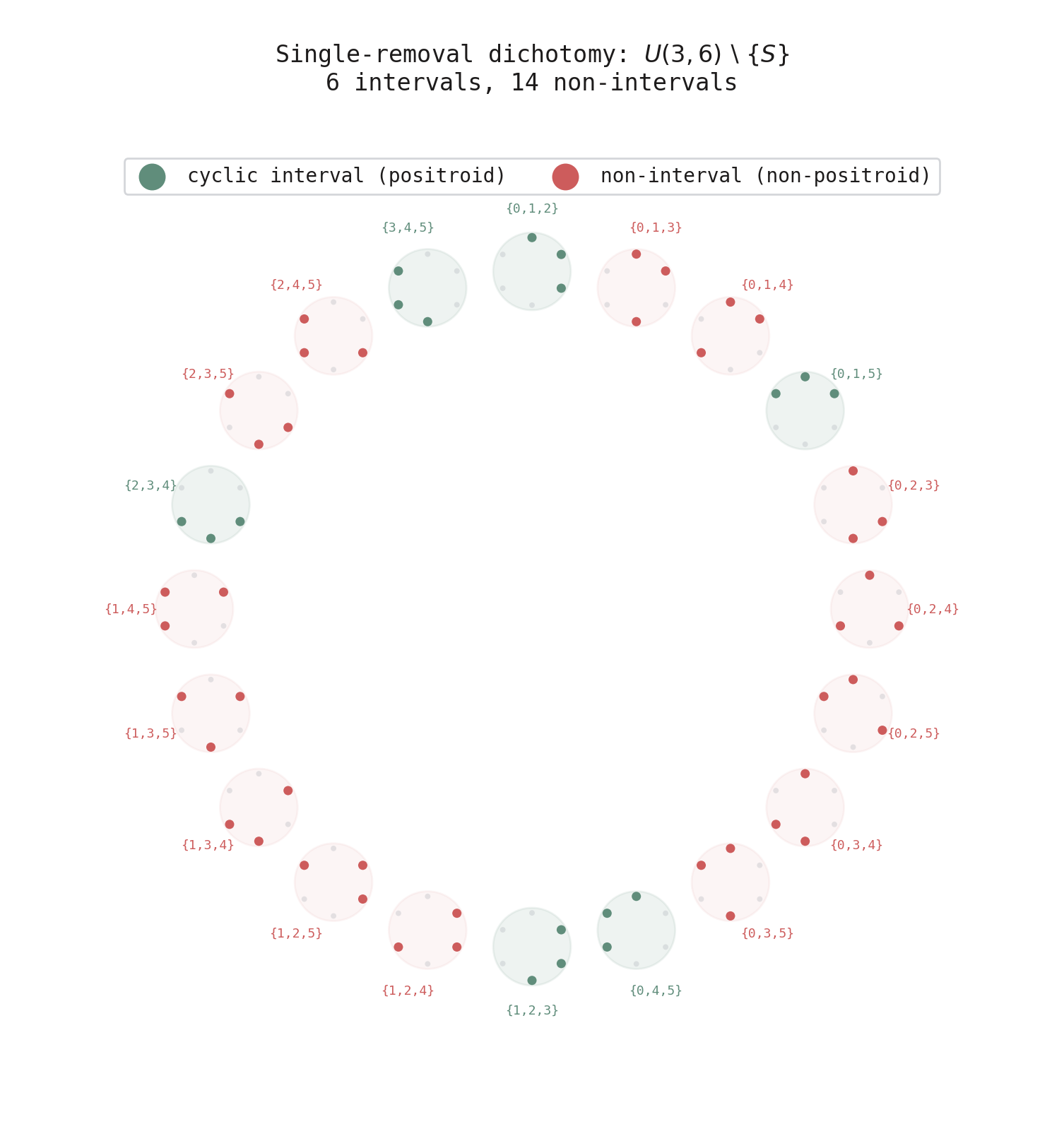
Figure 4. All 20 three-element subsets of \([6]\), each shown as a mini-circle with the selected elements highlighted. Green subsets are cyclic intervals: removing them from \(U(3,6)\) gives a positroid. Red subsets are non-intervals: removing them gives a non-positroid. The corollary says this dichotomy is exact.
Computational Verification
Each proof step was checked independently for all parameters up to \(n = 9\):
- Gale-minimality: The cyclic interval \(\{j,\ldots,j+k-1\}\) is verified to be the Gale-minimum \(k\)-subset in order \(\leq_j\) for all \((n,k,j)\) with \(n \leq 8\).
- Key lemma: Every cyclic-interval non-basis is excluded from \(\mathcal{R}\) by failing the Gale condition at its starting index — verified for 130 cases.
- Over-inclusion mechanism: 128 cases found where non-interval non-bases survive Gale reconstruction (are in \(\mathcal{R}\) but not in \(\mathcal{B}\)), confirming this is how non-positroids arise.
- Full theorem: Exhaustively verified for 255 matroids formed by removing all possible subsets of cyclic intervals from \(U(k,n)\) for \((n,k)\) up to \((9,3)\) and \((8,4)\).
- Single-removal dichotomy: Perfect 766/766 for all \(n \leq 9\), \(k \leq 5\).
Worked Examples
To make the proof concrete, here are four cases that illustrate the mechanism.
\(U(2,4) \setminus \{0,1\}\) — positroid. The non-basis \(\{0,1\}\) is a cyclic interval starting at \(j=0\). In order \(\leq_0\), it’s the Gale-minimum 2-subset. Since it’s not a basis, \(I_0 = \{0,2\} \neq \{0,1\}\). Check: does \(\{0,1\} \geq_0 \{0,2\}\)? Comparing second elements: \(1 < 2\). Fails. So \(\{0,1\} \notin \mathcal{R}\), and the matroid is a positroid.
\(U(2,4) \setminus \{0,2\}\) — not a positroid. The non-basis \(\{0,2\}\) is not a cyclic interval (gap between 0 and 2). Since \(\{0,2\}\) isn’t any cyclic interval, every interval \(\{j,j+1\}\) is a basis, so \(I_j = \{j,j+1\}\) for all \(j\). Then \(\{0,2\}\) Gale-dominates all of them, so \(\{0,2\} \in \mathcal{R}\) but \(\{0,2\} \notin \mathcal{B}\). Not a positroid.
\(U(3,5) \setminus \{0,1,2\}\) — positroid. The non-basis \(\{0,1,2\}\) is a cyclic interval starting at \(j=0\). It’s the Gale-minimum 3-subset in \(\leq_0\), so \(I_0 \neq \{0,1,2\}\) implies the Gale condition fails. Excluded from \(\mathcal{R}\), positroid confirmed.
\(U(3,5) \setminus \{0,2,4\}\) — not a positroid. This is the canonical counterexample from the search. \(\{0,2,4\}\) is spread with gaps, not a cyclic interval. The necklace is \(I_j = \{j,j+1,j+2\}\) for all \(j\), and \(\{0,2,4\}\) Gale-dominates all of them. So \(\{0,2,4\} \in \mathcal{R}\) but \(\notin \mathcal{B}\). Not a positroid.
Open Questions
The dynamical conjecture. Does gradient descent on TP-weight networks always produce cyclic-interval non-basis patterns? By the theorem, this is equivalent to asking whether trained TP networks always yield positroid activation matroids. The answer may connect to gradient flow geometry on the TP manifold.
The non-TP baseline. Does gradient descent on unconstrained weight networks also produce only positroid matroids? If yes, TP structure is irrelevant and the phenomenon is purely about training dynamics. If no, then TP structure and training dynamics are jointly responsible — the most interesting case.
Multi-removal characterization. The theorem gives a sufficient condition (all non-bases are cyclic intervals implies positroid). The 58 positroids with non-interval non-bases show this is not necessary in general, but it is necessary and sufficient for single removal. What is the right characterization for multi-removal?
Higher rank. All experiments used \(d=2\) (rank-3 matroids). Higher-rank regimes may exhibit richer matroid structure. Multi-parameter TP constructions via the Loewner-Whitney factorization would enable testing in \(d \geq 5\).
Summary
I conjectured that TP-weight ReLU networks always produce positroid activation matroids, supported the conjecture with 800+ trials, disproved it by constructing 12,642 counterexamples, discovered a clean dichotomy between contiguous and spread non-basis patterns, proved a theorem explaining the dichotomy, and reformulated the conjecture as a statement about the implicit bias of gradient-based training. The revised conjecture — that trained TP networks only visit positroid matroids because gradient descent avoids non-interval non-basis patterns — connects positroid combinatorics to a central question in deep learning theory.
All experiment code — including the training loop, matroid construction, positroid verification, and counterexample search — is available at github.com/HarrisonTotty/positroid-structure-relu-networks.
Update: The Non-TP Baseline (2026-03-04)
The second open question — does gradient descent on non-TP networks also produce only positroid matroids? — is now resolved. TP structure matters. Non-TP trained networks can produce non-positroid matroids; TP-trained networks never do.
The Experiment
The challenge in designing a non-TP baseline is that most simple kernel alternatives (sinusoidal \(W_{ij} = 2 + \sin(a_i b_j)\), quadratic distance \(W_{ij} = (a_i - b_j)^2 + 1\)) produce only uniform matroids during training — zero discriminating power. The exponential kernel has a normal-convergence property: as parameters grow, hyperplane normals converge toward common directions, creating near-collinear normals and non-uniform matroids. Sinusoidal and quadratic kernels lack this.
The key was to design a parameterization that preserves normal convergence while breaking total positivity. The negated bidiagonal construction does this: start with a TP exponential matrix \(E_{ij} = \exp(a_i b_j)\), then left-multiply by a lower bidiagonal matrix \(B\) with alternating signs on the subdiagonal (\(B_{i+1,i} = (-1)^{i+1} \cdot 1.5\)). The result \(W = BE\) preserves the asymptotic convergence of the exponential kernel but disrupts total positivity through sign-scrambling in the finite regime.
Results
Over 60 moons trials (20 per \(H \in \{6, 8, 10\}\), 200 epochs each):
| Mode | Non-positroid rate | Non-uniform rate |
|---|---|---|
| tp_exponential | 0/60 (0%) | 13/60 (~22%) |
| negated_bidiagonal | 2/60 (~3%) | 15/60 (25%) |
Both modes produce non-uniform matroids at comparable rates, so the comparison is fair. But only the negated bidiagonal mode produces non-positroids.
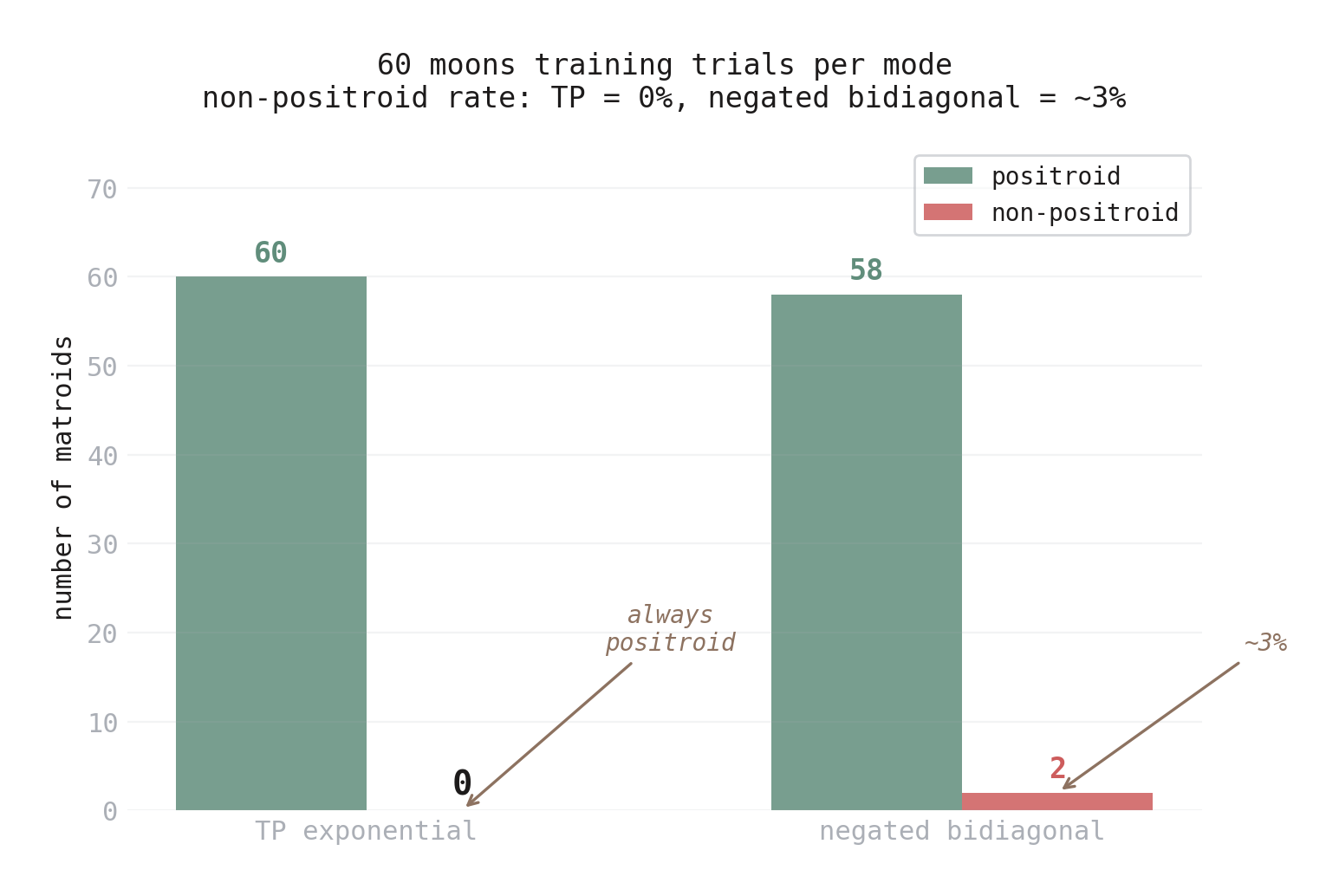
Figure 5. Non-positroid rates from 60 moons training trials per mode. TP exponential: zero non-positroids. Negated bidiagonal: 2 non-positroids (~3%). Both modes produce non-uniform matroids at comparable rates, so the difference is purely about positroid structure.
The two non-positroid cases:
-
\(H=6\), trial 11: rank-3 matroid with 16/20 bases. Non-bases: \(\{1,3,4\}, \{1,3,5\}, \{1,4,5\}, \{3,4,5\}\). Element 1 appears in 3 of 4 non-bases with gaps — a spread pattern, not a contiguous tail.
-
\(H=10\), trial 13: rank-3 matroid with 100/120 bases. Non-bases: 20 sets, all subsets of \(\{3,5,6,7,8,9\}\) — but element 4 is skipped. The gap at element 4 creates a non-contiguous support.
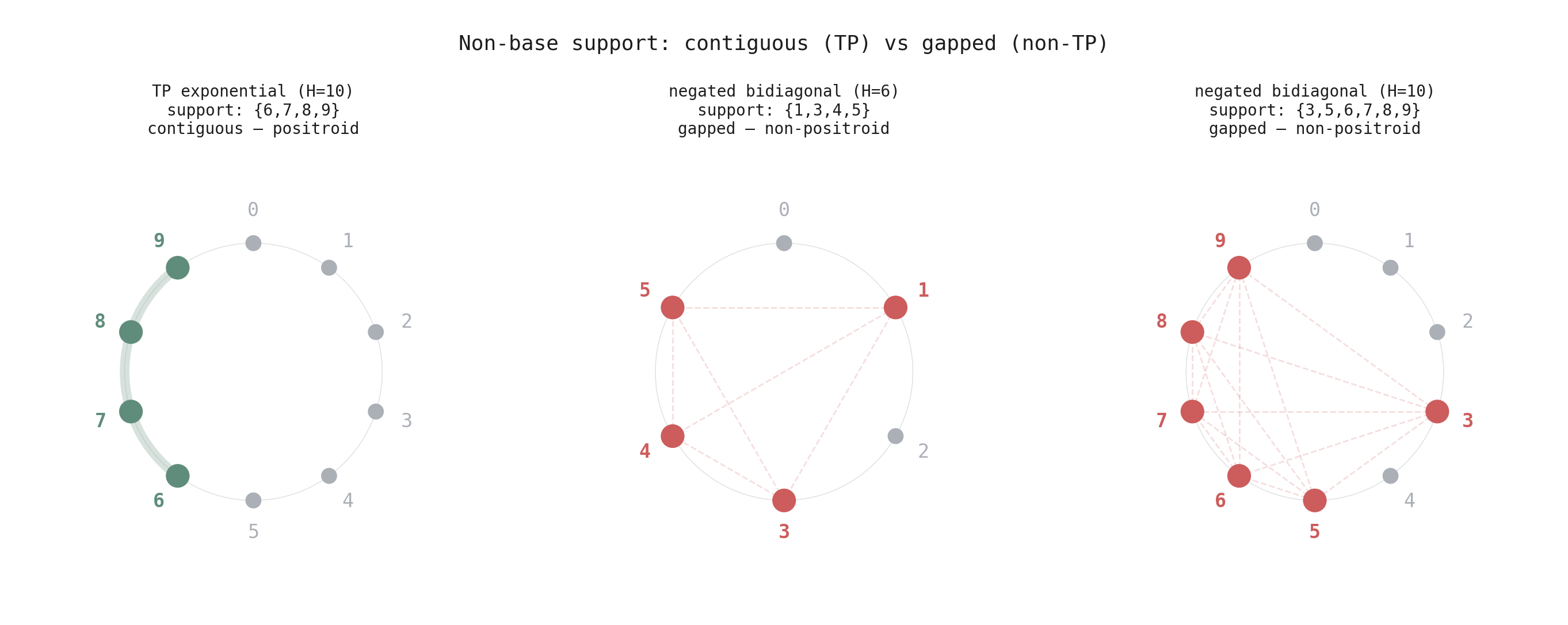
Figure 6. Non-base support on the circle. Left: TP exponential training produces a contiguous tail \(\{6,7,8,9\}\) — always a positroid. Center and right: negated bidiagonal training produces gapped supports \(\{1,3,4,5\}\) and \(\{3,5,6,7,8,9\}\) — both non-positroids. The gaps (missing elements within the support range) are the structural signature of non-positroid matroids from training.
The Mechanism
In TP-trained networks, the non-base support (the set of elements appearing in any non-basis) is always a contiguous tail \(\{H-m, H-m+1, \ldots, H-1\}\) for some \(m \geq k\). All \(\binom{m}{k}\) subsets of this tail are non-bases, meaning those \(m\) hyperplanes span a \((k-1)\)-dimensional subspace. The TP constraint forces converging normals to have consecutive indices — the column ordering of a TP matrix enforces monotone convergence patterns.
The bidiagonal perturbation disrupts this monotonicity. The alternating-sign subdiagonal of \(B\) scrambles the row ordering locally, allowing non-consecutive normals to converge. This produces gapped non-base supports — and gapped supports correlate perfectly with non-positroid structure in our data.
The causal chain is now clear:
\[\text{TP structure} \;\Rightarrow\; \text{contiguous non-base support} \;\Rightarrow\; \text{positroid}\]The first arrow is an empirical observation about training dynamics on the TP manifold. The second arrow follows from a generalization of the Contiguous-Implies-Positroid theorem stated above: the Contiguous-Support Positroid Theorem states that if every non-basis of a rank-\(k\) matroid on \([n]\) is contained in a cyclic interval \(T\) with \(\operatorname{rank}(T) \leq k - 1\), then the matroid is a positroid. A contiguous tail of \(m\) elements spanning a \((k-1)\)-dimensional subspace is exactly such an interval — so the tail-collapse pattern observed in TP training always gives a positroid.
Note that individual non-bases within the tail need not themselves be cyclic intervals (and often aren’t at larger \(H\)), so the original Contiguous-Implies-Positroid theorem is not the full explanation. The Contiguous-Support generalization covers these cases.
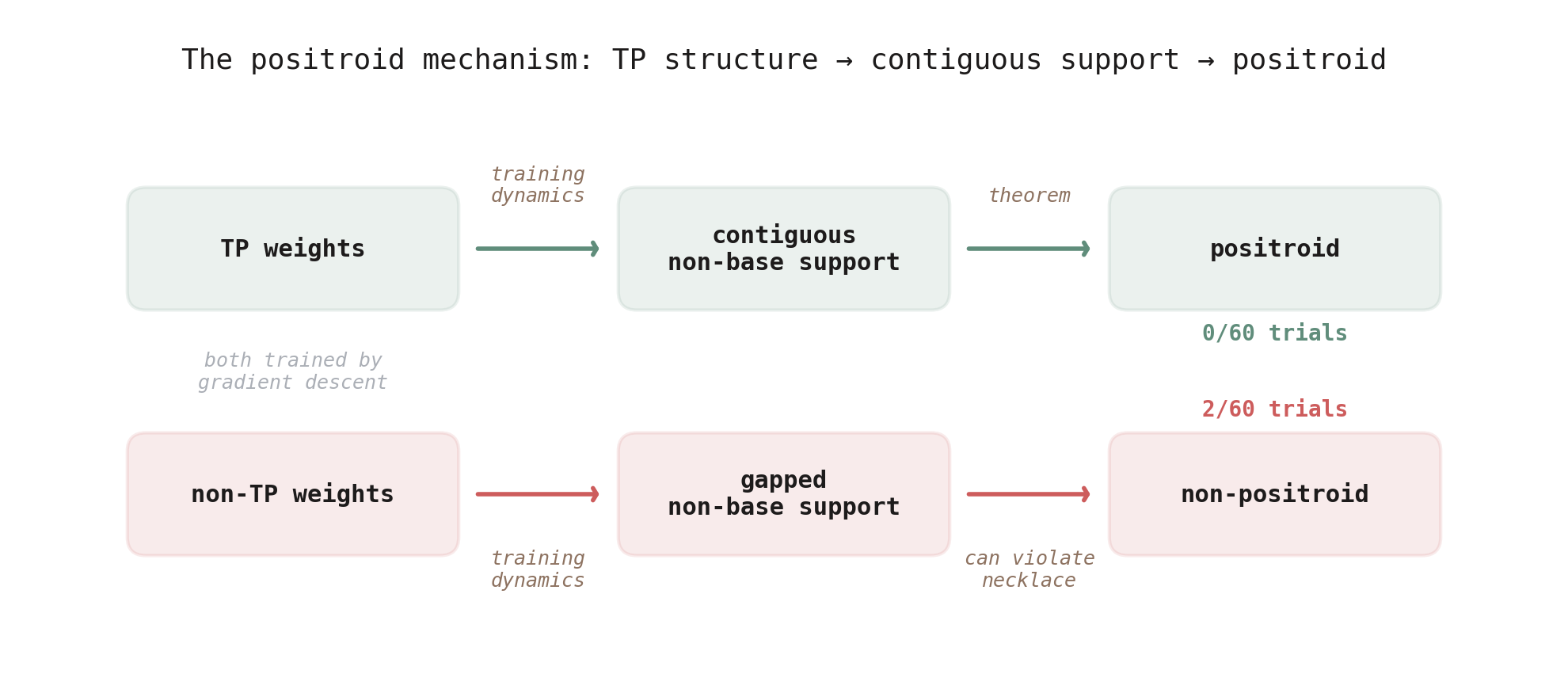
Figure 7. The positroid mechanism. Top: TP weights produce contiguous non-base support during training, which guarantees positroid structure by theorem. Bottom: non-TP weights can produce gapped support, which can violate the Grassmann necklace. Both paths use gradient descent — the difference is the weight constraint.
The Contiguous-Support Positroid Theorem
The second arrow in the causal chain — contiguous support implies positroid — is a theorem that generalizes the Contiguous-Implies-Positroid result from above.
Theorem (Contiguous-Support Positroid). Let \(M\) be a rank-\(k\) matroid on \([n]\). If for every non-basis \(S\) of \(M\) there exists a cyclic interval \(T_S \supseteq S\) with \(\operatorname{rank}_M(T_S) \leq k - 1\), then \(M\) is a positroid.
The original theorem is the special case where each non-basis \(S\) is itself a cyclic interval (take \(T_S = S\); a \(k\)-element dependent set trivially has rank \(\leq k - 1\)). The new theorem also covers the experimentally observed tail-collapse pattern: all non-bases are subsets of a single contiguous tail \(T = \{H-m, \ldots, H-1\}\) with \(\operatorname{rank}(T) \leq k - 1\), and the individual non-bases within the tail need not be cyclic intervals.
Proof
We show \(\mathcal{B} = \mathcal{R}\) using the Grassmann necklace / Gale reconstruction characterization.
\(\mathcal{B} \subseteq \mathcal{R}\) is the standard greedy argument (every basis Gale-dominates the necklace entry in each cyclic order).
\(\mathcal{R} \subseteq \mathcal{B}\) requires showing every non-basis is excluded from \(\mathcal{R}\). Let \(S\) be a non-basis, and let \(T \supseteq S\) be a cyclic interval with \(\operatorname{rank}(T) \leq k - 1\). Write \(T = \{j, j+1, \ldots, j+\lvert T \rvert-1\}\) and \(F = [n] \setminus T\).
In the cyclic order \(\leq_j\), every element of \(T\) precedes every element of \(F\). The greedy algorithm computing the necklace entry \(I_j\) processes all of \(T\) first, selecting at most \(\operatorname{rank}(T) \leq k - 1\) elements from \(T\). It then continues into \(F\) to reach size \(k\), so \(I_j\) contains at least one element of \(F\).
Now compare \(S\) and \(I_j\) in the \(\leq_j\) order. Let \(r = \operatorname{rank}(T)\). Then:
- \(I_j\) has \(r\) elements from \(T\) (at positions \(\leq \lvert T \rvert - 1\)) and \(k - r\) elements from \(F\) (at positions \(\geq \lvert T \rvert\)).
- \(S \subseteq T\), so all \(k\) elements of \(S\) sit at positions \(\leq \lvert T \rvert - 1\).
At index \(\ell = r + 1\): the \((r+1)\)-th smallest element of \(I_j\) is in \(F\) (position \(\geq \lvert T \rvert\)), while the \((r+1)\)-th smallest element of \(S\) is in \(T\) (position \(\leq \lvert T \rvert - 1\)). So \(s_{r+1} <_j i_{r+1}\), and the Gale condition \(S \geq_j I_j\) fails. Therefore \(S \notin \mathcal{R}\).
Since every non-basis is excluded from \(\mathcal{R}\), we have \(\mathcal{R} \subseteq \mathcal{B}\). Combined with \(\mathcal{B} \subseteq \mathcal{R}\): \(\mathcal{B} = \mathcal{R}\), so \(M\) is a positroid. \(\square\)
Corollary: Tail-Collapse Positroid
The experimentally observed pattern is a strict special case of the theorem.
Corollary. Let \(M\) be a rank-\(k\) matroid on \([n]\). If the non-bases of \(M\) are exactly the \(k\)-subsets of some cyclic interval \(T \subseteq [n]\) with \(\lvert T \rvert \geq k\), then \(M\) is a positroid.
Proof. Every \(k\)-subset of \(T\) is a non-basis, so \(\operatorname{rank}(T) \leq k - 1\). Take \(T_S = T\) for every non-basis \(S\). The main theorem applies. \(\square\)
This is exactly what TP training produces: the non-bases are all \(\binom{m}{k}\) subsets of a contiguous tail \(T = \{H-m, \ldots, H-1\}\), where those \(m\) hyperplanes span a \((k-1)\)-dimensional subspace. Note that the individual non-bases within the tail — sets like \(\{5, 7, 9\} \subset \{5, 6, 7, 8, 9\}\) — are typically not cyclic intervals, so the original Contiguous-Implies-Positroid theorem does not apply to them. The tail-collapse corollary handles these cases because it only requires the support to be a cyclic interval, not each non-basis individually.
A Necessary Subtlety
The hypothesis requires \(\operatorname{rank}(T) \leq k - 1\), not merely \(S \subseteq T\). The distinction matters: \(U(2,5) \setminus \{\{0,2\}\}\) has its only non-basis \(\{0,2\}\) contained in the cyclic interval \(T = \{0,1,2\}\), but \(\operatorname{rank}(T) = 2 = k\). The necklace entry \(I_0 = \{0,1\}\) stays entirely within \(T\) — no escape to \(F\) — and \(\{0,2\}\) passes all Gale conditions, giving \(\{0,2\} \in \mathcal{R} \setminus \mathcal{B}\). Not a positroid.
The rank condition ensures that the necklace entry must escape \(T\) into the complement, creating the Gale gap that excludes all \(k\)-subsets of \(T\) from \(\mathcal{R}\). Verified exhaustively for 627 configurations (all cyclic intervals \(T\) with \(\lvert T \rvert \geq k\) on \([n]\), \(n \leq 9\)).
Revised Conjecture
The Trained Positroid Conjecture should be stated as TP-specific:
For networks with TP weight matrices trained by gradient descent, the affine matroid is always a positroid.
The TP constraint is essential, not merely sufficient. Non-TP networks with the same convergence properties and comparable training accuracy can and do produce non-positroid matroids during training.